📅 Published: March 2026 | ✍️ By Digitating | 🏷️ AI SEO | ⏱️ 10 min read | 🔥 Trending topic
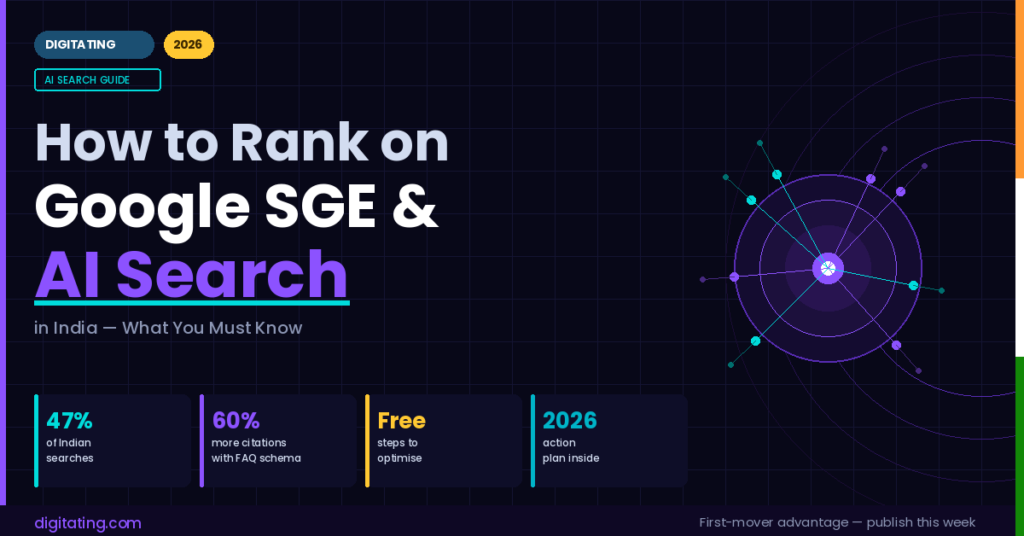
Something big changed in how Google works — and most Indian businesses haven’t noticed yet. When you search Google today, you often see a large AI-generated answer at the very top of the page, before any website links. This is Google’s AI Overview, and it now appears on roughly 47% of all searches in India as of early 2026.
The businesses whose content gets cited inside these AI answers are getting massive visibility — even without ranking #1. The businesses that haven’t adapted yet are watching their traffic quietly shrink. This guide explains exactly what Google SGE and AI Overviews are, why they matter for Indian businesses right now, and the 7 practical steps you can take this week to start appearing in them.
What Is Google SGE / AI Overview? (Plain English Explanation)
Google SGE — officially rebranded as Google AI Overview in 2024 — is an AI-powered feature that generates a summarised answer at the very top of search results, before any traditional blue links appear. It’s powered by Google’s Gemini AI model.
Instead of just showing a list of websites, Google’s AI now reads dozens of pages, synthesises the best information, and presents it as one coherent answer — with links to the sources it used. Those source links are the new gold. Being cited in an AI Overview gives your website brand visibility even when users don’t click through.
Old Google Search (pre-2024)
- 10 blue links on page 1
- Position #1 = maximum traffic
- Keywords = ranking factor
- Featured snippet = top of page
- Click to get the answer
Google AI Overview (2026)
- AI answer appears above all links
- Cited source = maximum visibility
- Clarity + credibility = ranking factor
- AI Overview = top of page
- Answer is shown — click is optional
Will AI Search Kill SEO? The Honest Answer for Indian Businesses
No — but it changes what “winning” looks like. This is the most important thing to understand before you change anything on your website.
Traditional SEO focused entirely on ranking in the blue links. AI Overview SEO — sometimes called GEO (Generative Engine Optimisation) — focuses on being the source that Google’s AI cites when it writes its summary. These aren’t opposite goals. They’re complementary. A page that ranks well in traditional search is more likely to be cited in AI Overviews too.
What is dying is the old approach of keyword stuffing, thin content, and writing for search crawlers instead of humans. Google’s Gemini model is smart enough to tell the difference between content written for people and content written to game an algorithm. The former gets cited. The latter gets ignored.
How Google’s AI Decides Which Content to Cite
Google’s AI doesn’t randomly pick sources. It looks for specific signals that tell it a piece of content is trustworthy, clear, and genuinely useful. Understanding these signals is the key to appearing in AI Overviews.
The 4 signals Google AI uses to pick sources:
| Signal | What it means | How to improve it |
|---|---|---|
| Clarity | Can the AI extract a clear answer quickly? | Put a direct 50-word answer right after each H2 heading |
| E-E-A-T | Is the author experienced, expert, authoritative, trustworthy? | Add author bio, real examples, original data, credentials |
| Structure | Is the content organised with headings, lists, and schema? | Use H2/H3 headings, bullet lists, FAQ schema markup |
| Speed | Does the page load fast on mobile? | Score 70+ on PageSpeed Insights — especially mobile |
Step 1 — Write “Atomic Answers” Under Every Heading
An Atomic Answer is a short, self-contained paragraph of 40–60 words placed directly below each H2 heading that answers the section’s question clearly and completely. This is the single most effective thing you can do to get cited in AI Overviews.
Google’s AI scans your content looking for passages it can extract and use. If the first thing after your heading is a clear, direct answer — you become the obvious source to cite. If the first thing is fluff, caveats, or keyword padding — the AI moves on to the next site.
❌ What NOT to write (AI ignores this)
- “Local SEO is a very important topic that many businesses are starting to pay attention to these days, and there are many different factors that can affect your rankings…”
✔ Atomic Answer format (AI cites this)
- “Local SEO is the process of optimising your website and Google Business Profile to appear in location-based searches. It helps businesses rank in Google Maps and the Local Pack for searches like ‘SEO agency Vadodara’.”
Example Atomic Answer — use this structure on every H2 in your blog posts
[H2 Heading: What is Google AI Overview?]
Google AI Overview is an AI-generated summary that appears at the top of search results before any website links. Powered by Google’s Gemini model, it synthesises information from multiple sources to answer a query directly. Websites cited as sources get brand visibility even when users don’t click through.
Step 2 — Add FAQ Schema Markup to Every Blog Post
Pages with FAQ schema markup are 60% more likely to appear in AI Overviews than pages without it. FAQ schema tells Google’s AI exactly which parts of your content are questions and answers — making it dramatically easier for the AI to extract and cite your content.
How to add FAQ schema in WordPress (two methods):
- Yoast SEO method (recommended): In Gutenberg editor, add a “Yoast FAQ” block from the block inserter. Type your questions and answers directly. Yoast automatically adds the correct schema markup.
- Rank Math method: Add a FAQ block in Gutenberg. Rank Math’s FAQ block also auto-generates schema — no coding needed.
What questions to include in your FAQ section:
- Look at the “People Also Ask” boxes on Google for your main keyword — these are real questions people ask
- Include “how”, “what”, “why”, “when”, and “is” questions — these are the formats that most frequently trigger AI Overviews
- Keep each answer between 40–80 words — short enough to be extracted, long enough to be useful
- Use your focus keyword naturally in at least one question
Step 3 — Build Your E-E-A-T Signals
E-E-A-T stands for Experience, Expertise, Authoritativeness, and Trustworthiness — and in 2026, it’s the most important concept in SEO. Google’s AI heavily weights E-E-A-T signals when deciding which sources to cite in AI Overviews. A page written by an anonymous author with no credentials will almost never be cited over a page with a clear expert behind it.
How to build E-E-A-T on digitating.com:
- Experience: Add real case studies with actual numbers — “We helped a Vadodara client go from 50 to 800 monthly visitors in 4 months.” Personal, verifiable experience is something AI cannot copy from other sites.
- Expertise: Add a detailed author bio with your name, photo, years of experience, and specific credentials to every blog post. Google’s AI checks author information.
- Authoritativeness: Get mentioned on other websites — guest posts, local directories, news mentions. Each external reference to “Digitating” as a source strengthens your authority.
- Trustworthiness: HTTPS (already done), clear contact info, Privacy Policy, no broken links, accurate information that matches other trusted sources.
Step 4 — Restructure Your Existing Blog Posts
You don’t need to write new content to start appearing in AI Overviews. Your existing blog posts just need restructuring. Google’s AI rewards content that is easy to parse — clear headings, short paragraphs, direct answers, and structured lists.
The 5-minute restructuring checklist for each post:
- Add an Atomic Answer (40–60 words) immediately after the main H2 heading
- Break long paragraphs — no paragraph over 4 sentences
- Convert walls of text into bullet lists wherever you have 3+ items in a row
- Add a FAQ section at the bottom with 4–6 questions using Yoast FAQ block
- Add a “Last updated” date to the post — freshness matters for AI citations
Step 5 — Optimise for Conversational and Voice Search
AI Overviews are deeply connected to how people speak when they search — especially in India, where voice search is exploding. Over 75% of Indian internet users search on mobile, and a growing share search by voice in Hindi, Hinglish, and English.
Google’s AI is trained on conversational language. Content written in a natural, question-and-answer style matches how the AI “thinks” and is far more likely to be cited than formal, academic-style writing.
How to write for voice search and AI in India:
- Use question-format headings: “What is local SEO?” instead of “Local SEO Overview”
- Write like you’re explaining to a customer: Simple sentences, everyday words, no jargon
- Include “near me” content: “If you’re searching for an SEO agency near you in Vadodara…” — this matches how Indian voice searches are phrased
- Target Hinglish questions: Consider adding a section addressing how Indian users actually phrase searches — “digital marketing kaise kare” type intent even in English articles
Step 6 — Fix Your Technical SEO for AI Crawling
Google’s AI cannot cite content it can’t properly read. Technical issues that were minor in traditional SEO become dealbreakers in AI Overview optimisation. The AI needs to be able to crawl, read, and understand your pages completely.
Technical checklist for AI Overview eligibility:
Must-have technical requirements
- HTTPS enabled — AI will not cite non-secure pages
- Mobile PageSpeed score 70+ (test at pagespeed.web.dev)
- No broken links on pages you want cited
- XML sitemap submitted to Google Search Console
- Structured data (schema) added — at minimum Article and FAQ schema
- No “noindex” tags on pages you want in AI Overviews
- Images have descriptive alt text — AI is now multimodal (reads images too)
- Core Web Vitals passing — LCP under 2.5s, CLS under 0.1
Step 7 — Track Your AI Overview Appearances
You can’t manage what you don’t measure. Here’s how to track whether your content is being cited in AI Overviews — using only free tools.
Free tracking method using Google Search Console:
- Go to Search Console → Performance → Search Results
- Look for keywords with high Impressions but low CTR (click-through rate) — under 2%
- These are almost certainly keywords where an AI Overview is showing your content but users aren’t clicking through to your site
- This is actually good news — it means Google’s AI is reading your content. Now optimise that page to also appear as a cited source with a clickable link
- Add more specific details, original data, and a stronger FAQ section to those pages
Complete AI SEO Checklist — Apply to Every Blog Post on Digitating.com
Content structure
- Atomic Answer (40–60 words) placed right after the first H2 heading
- All H2 sections have a direct answer in the first paragraph
- No paragraph longer than 4 sentences
- Lists used wherever 3+ items appear in sequence
- FAQ section added at bottom with Yoast FAQ block (min. 5 questions)
E-E-A-T signals
- Author name and photo visible on the post
- Author bio includes experience, credentials, location (Vadodara)
- At least one real example, case study, or original data point
- “Last updated” date shown on the post
Schema & technical
- Article schema set in Yoast → Schema tab
- FAQ schema added via Yoast FAQ block in Gutenberg
- Featured image has descriptive alt text
- Internal links to 3+ related posts
- Mobile PageSpeed score 70+ confirmed
Frequently Asked Questions
What is Google SGE and is it available in India?
Google SGE — now officially called Google AI Overview — is an AI-generated summary that appears at the top of search results before any website links. It is powered by Google’s Gemini model. Yes, it is fully active in India for English-language searches as of 2024, and is expanding to Hindi and other Indian languages through 2026.
Will Google AI Overview reduce my website traffic?
For simple informational queries, yes — some users will get their answer from the AI summary without clicking. However, for commercial queries like “SEO agency Vadodara” or “digital marketing services India”, AI Overviews still link to specific businesses and can actually increase click-through rates by up to 18% for cited sources. The key is to optimise your content to be cited, not just indexed.
How long does it take to appear in Google AI Overviews?
Pages that already rank in the top 10 and have strong E-E-A-T signals can see improved AI Overview visibility within a few weeks of adding FAQ schema and restructuring content. For newer sites or pages with low authority, building the foundational signals typically takes 2 to 4 months of consistent effort.
Can a small Indian business website appear in Google AI Overviews?
Yes — and this is one of the most exciting things about AI search. AI Overviews are more democratic than traditional SEO. A well-structured, specific answer from a small Vadodara business can appear in an AI Overview above results from national brands, because the AI rewards clarity and relevance over domain authority alone.
What is the difference between SEO and GEO in 2026?
Traditional SEO focuses on ranking in the blue-link results. GEO — Generative Engine Optimisation — focuses on being cited as a source inside AI-generated summaries. In 2026, you need both. The good news is that the foundations of good SEO (quality content, fast site, clear structure, credible author) directly support GEO success as well.
What to Do This Week — Your Action Plan
You don’t need to rebuild your entire website to start benefiting from AI search. Here’s a realistic plan for this week:
- Day 1: Go to your top 3 blog posts → add an Atomic Answer right after the first H2 heading on each one
- Day 2: Add a Yoast FAQ block to those same 3 posts with 5 questions each
- Day 3: Add your name, photo, and author bio to all existing posts
- Day 4: Run your top posts through PageSpeed Insights → fix the top 3 speed issues
- Day 5: Search your main keywords in Google (incognito) → see if AI Overviews appear → note which sites are being cited and why
These five actions take less than 3 hours total and can meaningfully improve your AI Overview visibility within the next 30 days.
🤖 Need help making your website AI-search ready? Digitating specialises in helping Indian businesses adapt their SEO strategy for Google’s AI-powered search. We audit your existing content, restructure it for AI citation, and implement FAQ schema — so your business starts appearing in Google AI Overviews.
Digitating is a result-driven digital marketing agency based in Vadodara, Gujarat. We help Indian small businesses and startups grow their online presence through SEO, content marketing, and social media strategy. Our blog covers practical, India-specific digital marketing advice — no theory, just what actually works.
🌐 digitating.com | 📧 contact@digitating.com | 📞 +91 88662 00624 | 📸 @digitating
Author
-
Rahi Shah is a results-driven Digital Marketing Expert with 8+ years of experience in SEO, PPC, Social Media Marketing, and Performance Marketing. With a Master's in Computer Applications, she has helped E-commerce, SaaS, and B2B brands scale their digital presence and boost ROI through data-driven strategies. Rahi specializes in high-impact campaigns, marketing automation, and AI-powered growth solutions. She also offers consulting services through her brand, Digitating.