📅 Published: April 2026 | ✍️ By Rahi Shah, Digitating | 🏷️ SEO Strategy | ⏱️ 10 min read | 🇺🇸🇬🇧 For UK & US small business owners
You are considering investing in SEO for your small business. Before you commit, you want a straight answer: how long will it actually take? Not the optimistic agency pitch — the real, honest timeline based on what actually happens in 2026.
This guide gives you exactly that. A month-by-month breakdown of what to expect, the five factors that speed results up or slow them down, and the one number most SEO providers never tell you — when you will actually see a return on your investment.
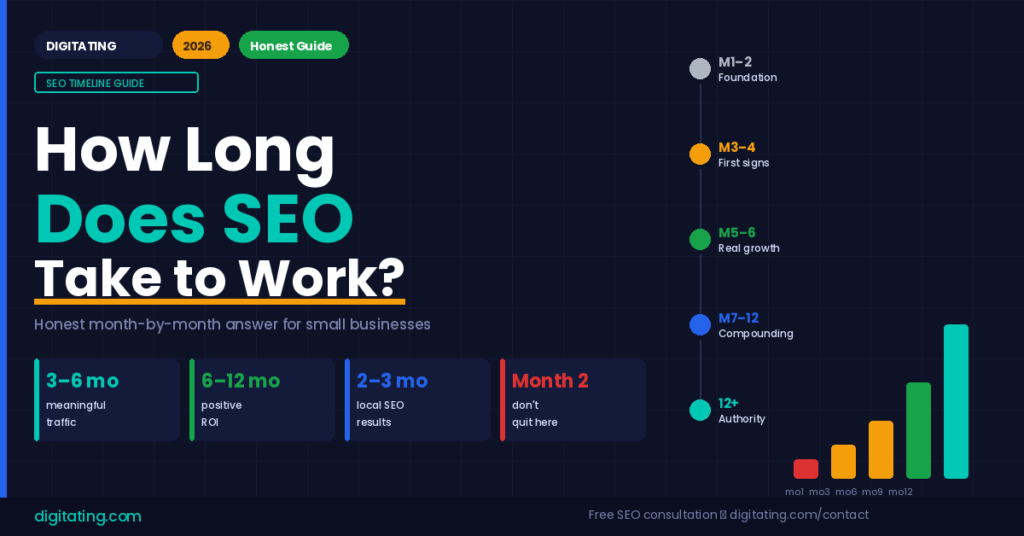
💡 Quick answer: For most small businesses, SEO takes 3–6 months to show meaningful ranking improvements and 6–12 months to deliver a clear positive ROI. Local SEO (Google Maps, local searches) is faster — meaningful results often appear within 2–3 months. The businesses that quit after 2 months are the ones who never find out what month 6 would have looked like.
The Honest Month-by-Month SEO Timeline
Here is exactly what happens — and what does not happen — during each phase of an SEO campaign for a small business starting from scratch in 2026.
Months 1–2
Foundation — Nothing visible yet (this is normal)
Google is discovering your content for the first time. Technical SEO issues are being fixed. Title tags and meta descriptions are being rewritten. Your sitemap is submitted. New blog posts are being indexed. You will see your impressions in Google Search Console start to climb — this is a positive sign — but clicks remain near zero. Do not judge SEO by month 2. The work done here determines everything that comes later. Businesses that quit here have wasted their investment and handed a head start to their competitors.
Months 3–4
First signs — Rankings start moving
This is when you see the first green shoots. Long-tail keywords (specific 4–6 word phrases with low competition) begin appearing on pages 1–2. Google Search Console shows CTR improvements from title tag fixes. Your Google Business Profile starts appearing more in local searches. Organic clicks begin — slowly at first, perhaps 1–5 per day. Traffic is up 20–40% from your baseline. This is the moment most businesses get excited and start seeing the compounding effect begin.
Months 5–6
Real growth — Consistent organic traffic
Multiple target keywords are now on page 1. Organic enquiries start coming in directly. Blog content from months 1–3 is ranking and bringing new visitors every day without any additional work. Traffic is up 50–100% from your starting point. Your cost per lead from SEO is already lower than paid ads. This is the month most small businesses reach the break-even point on their SEO investment. From here, the trajectory is upward.
Months 7–12
Compounding — Returns accelerate
This is where SEO becomes genuinely powerful. Content published in month 1 is now bringing daily traffic and leads without any ongoing cost. New content ranks faster because your domain has built authority. You are ranking for keywords you did not even target — Google starts understanding your expertise. Traffic is 2–4x your starting baseline. Leads are consistent and predictable. Businesses that reached this point consistently describe it as their best marketing investment. The cost per lead drops every month as the content compounds.
12+ months
Authority — Market leadership in your niche
Your site is an established authority in your topic. You rank for dozens or hundreds of keywords. New blog posts reach page 1 within days instead of months. Competitors start referencing your content. Organic traffic generates consistent revenue month after month — without the ongoing cost of paid ads. Unlike ads that stop the moment you stop paying, SEO keeps working indefinitely. Businesses that started SEO 12 months ago are now winning customers their competitors are paying to attract.
Local SEO Is Faster — Here’s Why
If your business serves customers in a specific city or region, local SEO works significantly faster than national SEO. The reason is simple: instead of competing with every business in the country for a keyword, you are only competing with businesses in your local area — a much smaller pool.
| Type of SEO | First results | Meaningful traffic | Strong ROI |
|---|
| Local SEO (Google Maps, local searches) | 4–8 weeks | 2–3 months | 4–6 months |
| Blog / content SEO (long-tail keywords) | 6–10 weeks | 3–4 months | 5–7 months |
| National / competitive SEO | 3–5 months | 6–9 months | 9–15 months |
| Brand new domain (sandbox period) | 4–6 months | 7–10 months | 12–18 months |
💡 For most small businesses — a combination of local SEO (fastest) and targeted blog content (medium speed) gives you the best of both worlds. Fix your Google Business Profile and start publishing 2 well-optimised blog posts per month. This combination delivers early wins from local while the content compounds over time.
5 Factors That Speed Up or Slow Down Your SEO Timeline
🌐
1. Domain age and history
A website that has been live for 3+ years ranks faster than a brand new domain. New sites go through what is called the “Google Sandbox period” — a 3–6 month window where Google is more cautious about ranking you, regardless of how good your content is. If your domain is new, accept this and use the time to build a strong content foundation. If your domain is established, you have a significant head start.
⚙️
2. Technical health of your website
A slow, broken, or hard-to-crawl website makes SEO significantly slower. If your mobile PageSpeed score is below 60, or if you have crawl errors, broken links, or duplicate content — Google spends its first few months of your campaign just fixing problems rather than ranking you. Getting your technical foundation right in month 1 compresses your entire timeline.
📝
3. Content quality and publishing frequency
Businesses that publish 2–4 well-optimised blog posts per month consistently reach meaningful traffic in 4–5 months. Businesses that publish sporadically or publish thin, generic content take 9–12 months for the same result. Consistency is more important than volume — one excellent post per week beats five mediocre posts per day. Target specific, long-tail questions your customers actually search for.
🏆
4. How competitive your market is
A plumber in a town of 10,000 people competes against 3–4 other businesses. A plumber in Houston competes against hundreds with years of SEO investment. The more competitive your market and keywords, the longer the timeline — and the more content and links you need. This is why targeting long-tail, specific keywords is so important for small businesses: you avoid competing directly with well-funded competitors until you have built enough authority to do so.
🔗
5. Backlinks — other sites linking to yours
Backlinks (links from other websites pointing to yours) remain one of Google’s strongest ranking signals. A site with 50 quality backlinks from relevant industry websites will outrank an identical site with zero backlinks almost every time. Building links takes time — but you can accelerate it by creating genuinely useful content that others want to reference, getting listed in local and industry directories, and reaching out to complementary businesses for mentions.
Why Businesses Quit SEO Too Early — and What They Miss
The most common mistake small business owners make with SEO is stopping after 2–3 months because they have not yet seen significant results. This is completely understandable — you are investing money and not seeing an obvious return yet. But stopping at month 2 is like planting seeds, watering them for two weeks, and then pulling them out because nothing has grown yet.
❌ Business that quit at month 2
- ✗Wasted months 1–2 of investment
- ✗Never saw month 5–6 breakthrough
- ✗Competitor kept going and now owns the rankings
- ✗Back to paying for ads with no SEO asset built
- ✗Has to start from scratch if they try again
✔ Business that committed to 6 months
- ✔First organic enquiries arrive in month 4–5
- ✔Traffic 2x by month 6, compounding monthly
- ✔Owns rankings competitors now can’t easily take
- ✔Cost per lead drops every month automatically
- ✔Content keeps generating traffic for years
SEO vs Google Ads — The Honest Comparison
If you need customers next week, run Google Ads. SEO cannot help you in the next 30 days — that is simply not how it works. But if you can invest consistently for 6 months, SEO becomes your most cost-effective long-term marketing channel.
| Google Ads | SEO |
|---|
| Time to first results | Same day | 3–6 months |
| What happens if you stop paying | Traffic stops immediately | Traffic continues indefinitely |
| Cost per lead over time | Stays the same or increases | Drops every month as content compounds |
| Builds a long-term asset | No | Yes — content and rankings are owned |
| Best for | Immediate leads, product launches | Sustainable long-term growth |
| For most small businesses | Use while SEO builds | Primary long-term strategy |
⚠️ The smart approach: Run Google Ads to generate leads in the short term while your SEO builds in the background. At month 6, when organic traffic starts flowing consistently, gradually reduce ad spend as your SEO covers more and more of your customer acquisition. By month 12, many small businesses find they can run their SEO traffic alone — turning their ad budget into pure profit.
Frequently Asked Questions
How long does SEO take to work for a small business?
For most small businesses, SEO takes 3–6 months to show meaningful ranking improvements and 6–12 months to deliver a clear positive return on investment. Local SEO (Google Maps and local searches) works faster — most businesses see meaningful results within 2–3 months. The exact timeline depends on your domain age, how competitive your market is, the quality and frequency of your content, and your website’s technical health.
Why does SEO take so long?
SEO takes time because Google does not rank websites based on effort alone — it ranks based on trust, relevance, and authority, all of which take time to establish. Google needs to crawl your content, index it, observe how users interact with it, and compare it against every other page competing for the same keywords. New domains also go through a “sandbox period” where Google is cautious about ranking them until their legitimacy is established. This is not a flaw — it is what keeps Google results trustworthy.
Can SEO work faster than 3 months?
Yes — for specific types of results. Title tag and meta description improvements can increase your CTR within 1–2 weeks of Google re-crawling your pages. Google Business Profile optimisation can improve your local map rankings within 4–6 weeks. Targeting very low competition long-tail keywords can produce page 1 rankings in 4–8 weeks for new content. The “3–6 months” timeline refers to broad, meaningful traffic growth — not these quick wins.
Is SEO worth it for a small business?
Yes — for businesses that can commit to 6+ months of consistent effort. Unlike paid advertising where your traffic stops the moment you stop paying, SEO builds a permanent asset. Content published today will generate traffic for years. The cost per lead from SEO drops every month as your content compounds, making it one of the highest-ROI marketing investments for small businesses over a 12-month horizon. The businesses that find SEO is “not worth it” are typically those who stopped at month 2–3 before results materialised.
How much content do I need to publish for SEO to work?
For a small business blog targeting local or niche keywords, publishing 2–4 well-optimised blog posts per month consistently produces meaningful results within 4–5 months. Quality is more important than volume — one thorough, well-structured post targeting a specific question outperforms five thin, generic posts every time. Focus on answering the exact questions your target customers search for before hiring a business like yours.
⏱️ Want to know exactly how long SEO will take for YOUR specific business — and what you should be doing in each month?
I’m Rahi Shah from Digitating. I offer free SEO consultations for small businesses — I’ll look at your website, your market, and your competition, and give you a realistic month-by-month plan with honest timelines. No fluff, no upsell pressure.
Book your free SEO consultation → digitating.com/contact
About the Author — Rahi Shah, Digitating
Rahi Shah is a digital marketing expert with 6+ years of experience helping small businesses in the UK, USA, and India grow through SEO and digital marketing. She runs Digitating — a results-focused practice specialising in SEO, Google Ads, and content strategy for small businesses.
🌐 digitating.com | 📧 contact@digitating.com | 📸 @digitating