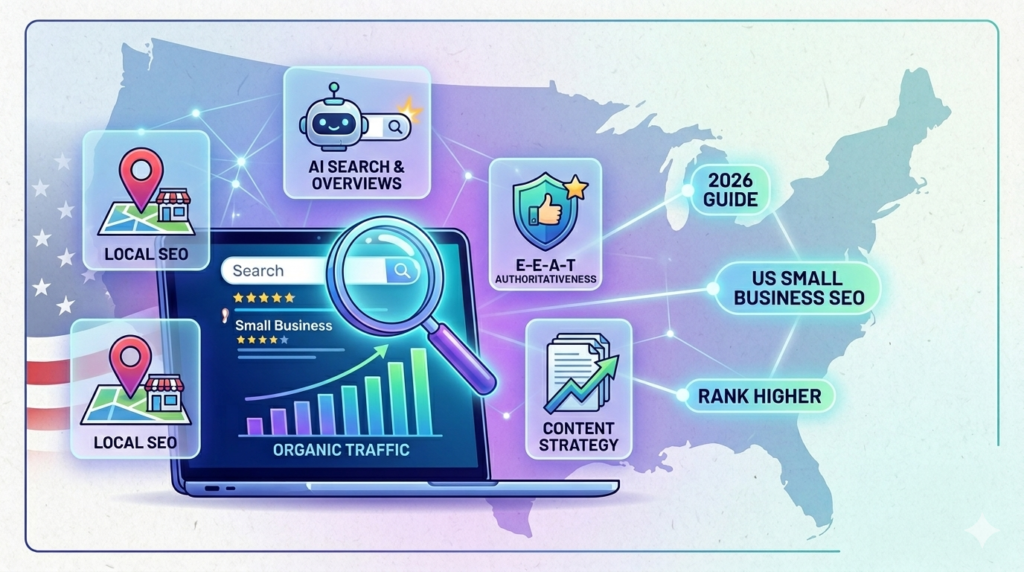
If you run a small business in the USA, you already know how competitive it is to get found online.
You are competing against big brands with massive budgets, hundreds of competitor websites, and now — AI-generated search results that push your listing even further down the page.
So what actually works for small business SEO in 2026?
The answer is not one magic trick. It is a combination of smart strategies that work together — and in this guide, Digitating breaks down exactly what those strategies are, why they work, and how you can start implementing them today.
Let us get into it.
Why SEO Still Matters for Small Businesses in 2026
Before the strategies, let us address the question many small business owners are asking right now:
“With AI taking over search, is SEO even worth it anymore?”
The short answer — yes, absolutely.
Here is why:
- Nearly 50% of all website traffic still comes from organic search
- Google’s AI Overviews now reach over 2 billion monthly users — but the content powering those answers comes from well-optimised websites like yours
- SEO delivers compounding returns — unlike paid ads that stop the moment you stop spending, every piece of optimised content keeps working for you 24/7
- Small businesses that invested in SEO early are now reaping the benefits while competitors scramble to catch up
The rules have changed. But the opportunity is bigger than ever for small businesses that get it right.
Strategy 1: Optimise for AI Search and Google’s AI Overviews
This is the biggest shift in SEO in 2026 and most small businesses are ignoring it completely.
Google’s AI Overview now appears at the top of search results for 80-88% of informational searches. Instead of showing ten blue links, Google summarises an answer — pulling content from websites it considers authoritative and well-structured.
Here is what this means for you: if your content is structured correctly, Google can feature your business in its AI answer — giving you massive visibility even without a top-10 ranking.
How to optimise for AI Overviews:
- Write in a clear question-and-answer format. Use headings like “What is…” or “How do I…” and answer directly below in 2-3 sentences
- Use structured headings (H2, H3) that clearly signal what each section is about
- Keep sentences short and factual — AI systems pull content that is easy to extract
- Add an FAQ section at the bottom of every page and blog post
- Use schema markup on your website — this helps AI systems understand your content faster
Think of it this way: you are not just writing for humans anymore. You are writing for AI systems that decide what answer to show millions of people.
Strategy 2: Master Local SEO — Even If You Think You Do Not Need It
If your small business serves customers in a specific city, state, or region in the USA, local SEO is your fastest path to getting found.
Here is the reality in 2026:
- Voice search queries are 3x more likely to be local than typed searches
- Google Business Profile listings often appear before organic website results
- AI-powered search systems heavily rely on local signals to recommend businesses
The local SEO checklist every US small business needs:
1. Google Business Profile (GBP) This is non-negotiable. Claim and fully optimise your GBP listing with:
- Accurate business name, address, phone number
- Updated business hours including holidays
- High-quality photos of your business, products, or team
- Regular posts (at least 1-2 per week)
- Responses to every single review — positive and negative
2. Consistent NAP (Name, Address, Phone) Your business information must be identical across your website, GBP, Yelp, Facebook, and every other directory. Even small differences like “St.” vs “Street” can hurt your rankings.
3. Local Keywords Include your city and state naturally in your page titles, meta descriptions, and content. For example: “affordable plumber in Austin Texas” or “best bakery in Brooklyn New York.”
4. Location-Specific Pages If you serve multiple cities, create a dedicated page for each one. A page titled “Digital Marketing Services in Chicago” will rank far better for Chicago searches than a generic services page.
5. Get More Reviews Reviews are a direct local ranking factor. Ask every happy customer to leave a Google review. A business with 50 reviews at 4.8 stars will consistently outrank a competitor with 5 reviews at 5 stars.
Strategy 3: Build E-E-A-T Into Everything You Do
E-E-A-T stands for Experience, Expertise, Authoritativeness, and Trust — and in 2026, it is the most important framework Google uses to evaluate your website.
This matters especially for small businesses because you have something big brands do not: genuine, real-world experience.
Here is how to demonstrate E-E-A-T on your website:
- Add author bios to every blog post — include credentials, years of experience, and a headshot
- Share real case studies — show actual results you have achieved for clients or customers, with numbers
- Display trust signals prominently — certifications, awards, memberships, BBB ratings, press mentions
- Link to credible external sources when making factual claims
- Keep your content updated — outdated blogs signal to Google that your site is not actively maintained
- Get backlinks from reputable local and industry websites — a mention from a local news site or industry association builds massive authority
The businesses that rank in 2026 are not the ones with the most content. They are the ones Google trusts the most.
Strategy 4: Focus on Long-Tail Keywords
Here is a secret that most small business owners miss: you do not need to rank for huge, competitive keywords to get results.
You cannot compete with Amazon, Forbes, or national chains for broad terms like “running shoes” or “digital marketing.” But you absolutely can rank for:
- “best running shoes for flat feet under $100”
- “affordable digital marketing for restaurants in Denver”
- “how to fix a leaky faucet in an old house”
These are called long-tail keywords — longer, more specific search phrases that have lower competition but much higher intent. The person searching “affordable digital marketing for restaurants in Denver” is far more likely to become a customer than someone searching “digital marketing.”
How to find long-tail keywords for your business:
- Type your main keyword into Google and look at the “People Also Ask” and “Related Searches” sections
- Use free tools like Google Keyword Planner or Ubersuggest
- Look at the questions your customers actually ask you — these are real keywords
- Check what your competitors are ranking for using a free tool like Semrush’s free tier
Target 1-2 long-tail keywords per blog post and you will start ranking faster than you ever thought possible.
Strategy 5: Create Content That Actually Answers Questions
Content marketing in 2026 is not about publishing as many blogs as possible. It is about publishing the right content that answers real questions your customers are searching for.
Google’s Helpful Content system actively filters out content written purely for SEO — thin articles, AI-generated fluff, and keyword-stuffed pages get penalised. What gets rewarded is content that genuinely helps the reader.
The content formula that works for small businesses in 2026:
- Find a question your ideal customer is actually asking — use Google’s “People Also Ask” or answer forums like Reddit and Quora in your niche
- Write a comprehensive answer — aim for 1,200-2,000 words for blog posts
- Use real examples from your own experience — this is your E-E-A-T in action
- Include a practical checklist or action steps — people love content they can immediately apply
- Add an FAQ section — this increases your chances of appearing in AI Overviews and featured snippets
- Update it every 6-12 months — fresh content consistently outperforms stale content
Consistency beats volume every time. One well-researched, genuinely helpful blog per week will outperform five thin, rushed posts.
Strategy 6: Fix Your Technical SEO Foundation
Even the best content will not rank if your website has technical problems that prevent Google from crawling and indexing it properly.
The technical SEO checklist for small businesses:
- Page speed — your website should load in under 3 seconds on mobile. Use Google’s PageSpeed Insights to check and fix issues
- Mobile-friendly design — over 60% of searches happen on mobile in 2026. If your site is not responsive, you are losing rankings
- HTTPS security — make sure your site uses HTTPS (the padlock icon). Google actively favours secure websites
- Clean URL structure — URLs should be short, descriptive, and include your target keyword (e.g., /seo-strategies-small-business-usa not /page?id=1234)
- XML sitemap — submit one to Google Search Console so Google knows which pages to index
- Fix broken links — use a free tool like Screaming Frog to find and fix 404 errors
- Add meta titles and descriptions to every page — many small business websites skip this entirely, costing them significant clicks
Technical SEO is not glamorous, but it is the foundation everything else is built on. A fast, secure, well-structured website will consistently outrank a slow, broken one — no matter how good the content is.
Strategy 7: Build Backlinks the Right Way
Backlinks — links from other websites pointing to yours — remain one of Google’s most important ranking signals. But the quality of backlinks matters far more than quantity in 2026.
Effective backlink strategies for US small businesses:
- List your business on reputable directories — Google Business Profile, Yelp, Chamber of Commerce website, BBB, industry-specific directories
- Get featured in local press — reach out to your local newspaper or online news site with a story about your business
- Write guest posts — contribute articles to industry blogs and websites in exchange for a link back to your site
- Create genuinely shareable content — original research, unique data, or comprehensive guides naturally attract backlinks over time
- Partner with complementary local businesses — a restaurant and a local events company might naturally link to each other
Avoid buying backlinks or using link farms — Google penalises these tactics aggressively in 2026, and the damage can take months to recover from.
Strategy 8: Track, Measure, and Improve
The businesses that win at SEO are not the ones with the best initial strategy. They are the ones that consistently track their results and improve based on data.
The free tools every small business should use:
- Google Search Console — shows you which keywords you rank for, how many impressions and clicks you are getting, and any technical issues on your site
- Google Analytics 4 — tracks your website traffic, where visitors come from, and what they do on your site
- Google Business Profile Insights — shows how customers are finding and interacting with your GBP listing
What to measure every month:
- Total organic clicks and impressions (are they growing?)
- Which keywords are you ranking for and at what positions?
- Which pages are getting the most traffic?
- How many visitors are converting into leads or customers?
Review your data once a month. Double down on what is working. Fix what is not. This simple habit separates businesses that see results from those that wonder why SEO is not working for them.
How Long Does SEO Take for Small Businesses?
This is the most common question — and the honest answer is: 3 to 6 months for initial results, 6 to 12 months for meaningful growth.
SEO is not a quick fix. It is a long-term investment. But here is what makes it worth it: every piece of content you publish, every backlink you earn, and every technical improvement you make stacks on top of everything before it. The growth compounds over time in a way paid advertising simply cannot match.
The businesses that start SEO today will be the ones dominating their local and niche markets in 2027.
Summary: Your 2026 Small Business SEO Action Plan
Here is everything in one place:
- Optimise for AI search — structure content with clear Q&A, headings, and FAQs
- Master local SEO — claim your GBP, get reviews, use location keywords
- Build E-E-A-T — show your experience, credentials, and real results
- Target long-tail keywords — go specific, not broad
- Create genuinely helpful content — answer real questions, update regularly
- Fix technical SEO — speed, mobile, HTTPS, meta tags, clean URLs
- Build quality backlinks — directories, press, guest posts, partnerships
- Track and improve — use GSC and GA4, review monthly
Ready to Grow Your Business with SEO?
At Digitating, we help small businesses in the USA and India build SEO strategies that actually drive results — not just rankings.
If you want a free SEO audit of your website to see exactly where you stand and what to fix first, contact us today. We would love to help your business grow.
Want to understand how much SEO costs for small businesses in the USA? Read our detailed breakdown: How Much Does SEO Cost for Small Businesses in the USA? (2026 Honest Guide)